Fabric & construction
What is the best material for men's underwear?
Key takeaways
- There is no single best material — each one wins on a different axis, and the honest answer depends on whether you are sitting in air conditioning, sweating, or packing for a week.
- Cotton is the most breathable and the slowest to smell, but it absorbs sweat and holds it against the skin, and it loses its shape over a day.
- Fine synthetics move moisture and hold their fit, and they smell faster. That trade is the whole decision for most men.
- Most fabric sold as ‘bamboo’ is viscose rayon chemically processed from bamboo pulp. US labelling rules require it to be called rayon, and brands have been penalised for calling it bamboo.
- Merino resists odour better than anything else in this list and is the most fragile and most expensive of them; underwear-weight merino is usually blended with nylon to survive.
- No fabric is medically ‘healthiest’. Fit, dryness and how often a pair is washed and replaced affect skin far more than which fibre it is made from.
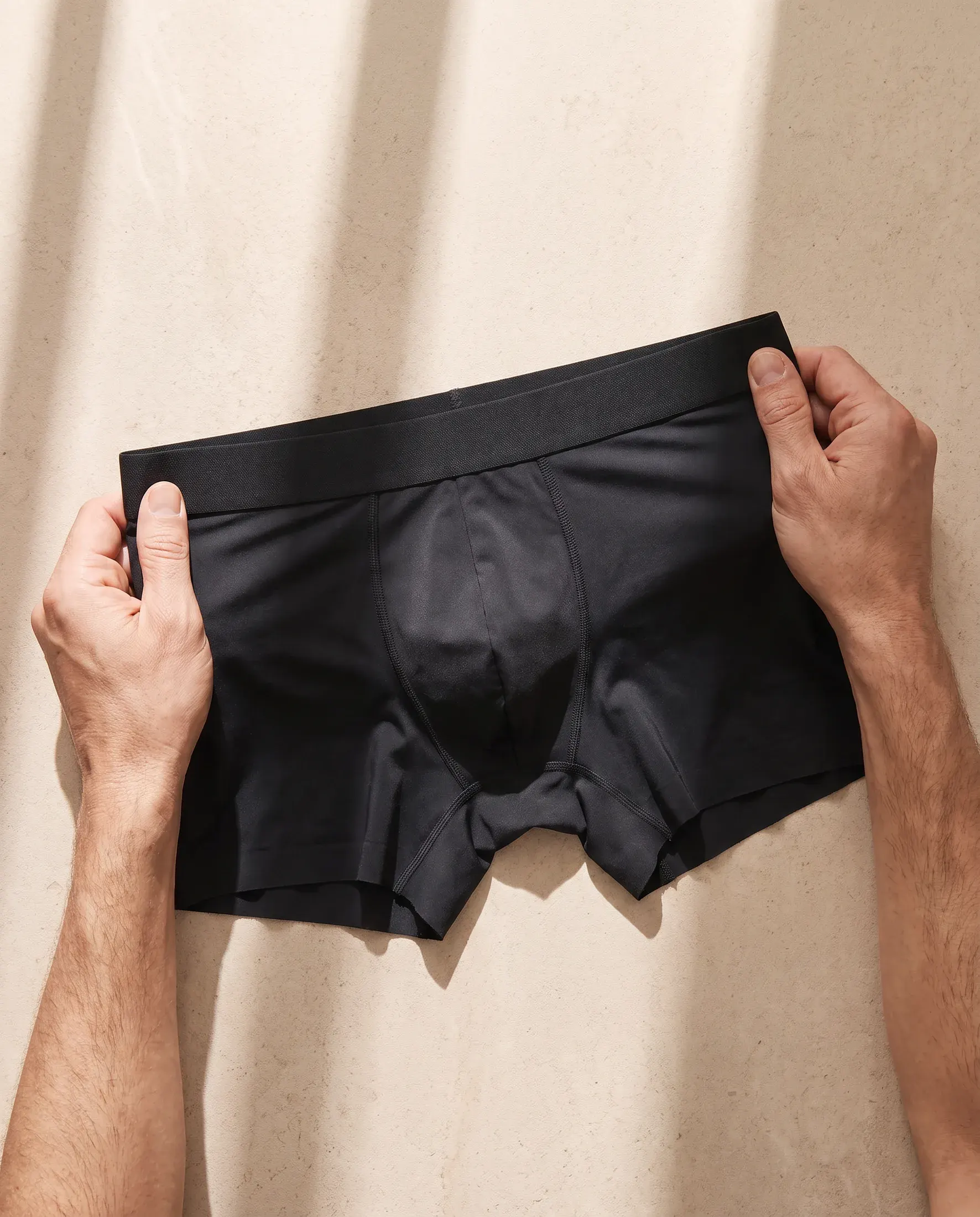
What is the best material for men's underwear?
For most men in most situations, a fine knit with elastane — whether that base is cotton, modal or a synthetic — outperforms any pure fibre, because the elastane is what keeps the garment fitting the way it did when you put it on. Beyond that, the choice is a trade between breathability and odour on one side, and moisture handling and shape retention on the other.
Pure anything tends to disappoint in underwear. 100% cotton relaxes and sags; 100% polyester feels plasticky and holds smell; 100% modal is beautiful and delicate. Nearly every good pair you have ever worn was a blend, and the elastane content — usually 5–12% — is doing more work for your comfort than the headline fibre is.
| Fabric | Breathability | Odour resistance | Moisture | Durability | Best for |
|---|---|---|---|---|---|
| Cotton | High | Good | Absorbs and holds it | Moderate | Everyday, cool conditions, sensitive skin |
| Modal / TENCEL | High | Good | Absorbs, dries faster than cotton | Low–moderate | Softness above all |
| ‘Bamboo’ (viscose rayon) | High | Good | Absorbs, slow to dry | Low | Softness; see the labelling section |
| Merino wool | High | Excellent | Manages it well, dries slowly | Low unless blended | Multi-day wear, travel, cold |
| Polyester | Moderate | Poor | Moves it to the surface | High | Sweat, sport, travel, shape retention |
| Nylon | Moderate | Poor | Moves it to the surface | Very high | Waistbands, durability, silky hand |
| Silk | High | Moderate | Absorbs | Very low | Luxury; impractical for daily wear |
Is bamboo underwear actually bamboo?
Usually not in the way the word implies. The overwhelming majority of fabric sold as ‘bamboo’ is viscose rayon: bamboo pulp dissolved in a chemical bath and extruded as fibre. US labelling rules require this to be described as rayon, and regulators have penalised retailers for marketing it as bamboo.
This matters because the marketing usually attaches the plant's properties to the finished fabric. Bamboo the plant grows fast and needs little pesticide — genuinely true. But almost none of that survives a process that breaks the plant down chemically and reconstitutes it. The resulting rayon is soft and breathable, and those are real qualities. They are qualities of rayon, not of bamboo.
| What it says | What it usually is | What to know |
|---|---|---|
| Bamboo / bamboo viscose | Viscose rayon from bamboo pulp | Chemically processed. Soft, breathable, not very durable |
| Rayon made from bamboo | The same thing, correctly labelled | The wording US rules require |
| Bamboo lyocell | Lyocell from bamboo, closed-loop solvent process | A genuinely cleaner process; rarer and costs more |
| Bamboo linen | Mechanically processed bamboo fibre | Actually bamboo fibre; rare, coarse, almost never used in underwear |
None of this makes bamboo viscose a bad fabric to wear — it is soft, breathable and pleasant. It makes it a poorly labelled one. If you like how it feels, buy it for that. Just know you are buying rayon, and that its durability is closer to modal than to cotton.
Is merino wool underwear worth it?
For travel and multi-day wear, yes — merino resists odour better than any other fibre here, which is why it is the standard for people who need to wear one pair for several days. For everyday use at home it is hard to justify: it costs several times more and wears out considerably faster.
- Merino's odour resistance is its genuine advantage and it is not marketing — it is the reason hikers and long-haul travellers pay for it.
- Underwear-weight merino is fragile. Almost all of it is blended with nylon (commonly 10–20%) purely so it survives being worn and washed.
- It is slow to dry, which undercuts it for heavy sweating despite its reputation.
- It is the most expensive option on this page by a wide margin, and it thins at friction points sooner than a synthetic will.
Is modal underwear good, and is it healthier than cotton?
Modal is softer than cotton, drapes better and dries faster, and it is the reason a lot of expensive underwear feels expensive. It is not healthier than cotton — both are breathable, absorbent and fine against skin. Modal is simply more comfortable and less durable.
Modal is a rayon made from beech pulp, so it sits in the same family as bamboo viscose — a regenerated cellulose fibre rather than a natural one straight off the plant. TENCEL modal and lyocell are branded versions produced in a closed-loop process that recovers most of the solvent, which is a meaningful environmental difference from conventional viscose.
The catch is durability. Modal pills and thins faster than cotton, and considerably faster than a synthetic. A modal pair that feels remarkable in month one often looks tired by month eight. That is the price of the hand-feel, and it is worth paying if that is what you care about.
What is the healthiest fabric for men's underwear?
No fabric is meaningfully healthier than the others for most men. What affects skin is whether a garment stays dry, whether it fits without compressing, and how often it is washed and replaced — not whether the fibre came from a plant, an animal or a polymer.
This question appears constantly in search results, and the answers are almost always given by a brand that sells exactly the fabric it names. We sell a polyester-elastane blend, so by that logic we should be telling you synthetics are healthiest. We are not, because the evidence does not support ranking fabrics that way.
- Stay dry. Trapped moisture against skin is the main driver of irritation and odour in any fabric.
- Fit properly. Compression at the waistband and leg hem does more visible damage to skin than fibre choice.
- Wash after each wear, cool, without fabric softener.
- Replace pairs when the knit has lost its recovery, rather than waiting for a hole.
- If you have a persistent skin problem, see a doctor. It is not a question an underwear brand can answer for you.
What we chose, and what it costs us
The Everyday Brief is being developed as a fine polyester-elastane knit. We chose it for moisture handling and shape retention — the fit at six in the evening matching the fit at seven in the morning. The cost of that choice is odour resistance, where it is the weakest option on this page.
We benchmarked against a garment labelled 88% polyester and 12% elastane, because it solved the problem we cared most about: a knit that recovers after every stretch rather than staying stretched. Cotton does not do that, and no amount of preference changes the fibre's behaviour.
The honest consequence is that our fabric needs washing after every wear and will never beat merino or cotton on smell. If odour between washes is your priority, we are not the right answer, and we would rather say so here than have you find out after paying us.
Frequently asked questions
What is the best material for men's underwear?
There isn't one best material. A fine knit with 5–12% elastane beats any pure fibre because it holds its fit. Beyond that: cotton and modal for breathability and low odour, synthetics for moisture and shape retention, merino for multi-day wear.
What is the healthiest fabric for men's underwear?
No fabric is meaningfully healthier for most men. Staying dry, fitting without compression, washing after each wear and replacing worn pairs matter far more than fibre type. Persistent skin problems are a question for a doctor.
Should men's underwear be 100% cotton?
Rarely. 100% cotton relaxes and loses its shape through the day, which is why almost all good cotton underwear includes a few percent elastane. Pure cotton is a reasonable choice if you prioritise breathability over fit.
Is bamboo underwear good for men?
It is soft and breathable, but most of it is viscose rayon chemically processed from bamboo pulp rather than bamboo fibre — US rules require it to be labelled rayon. Buy it for the feel, expect durability closer to modal than cotton.
Which is healthier, modal or cotton?
Neither. Both are breathable, absorbent cellulose fibres that are fine against skin. Modal is softer and dries faster; cotton is more durable. It's a comfort and longevity choice, not a health one.
Is merino wool underwear worth the money?
For travel and multi-day wear, yes — nothing resists odour better. For daily wear at home it's hard to justify: it costs several times more than the alternatives and wears through at friction points much sooner.
What is the best underwear material if I sweat a lot?
A fine synthetic knit, because it moves moisture to the surface to evaporate instead of absorbing and holding it against the skin. The trade-off is that it must be washed after every wear.
Where these numbers come from
- Bamboo labelling
- US labelling rules require fabric chemically processed from bamboo pulp to be described as rayon (or ‘rayon made from bamboo’) rather than bamboo, and regulators have taken enforcement action against retailers over bamboo claims. We describe the rule rather than quoting penalty figures.
- Fibre properties
- Standard textile-science characteristics: moisture regain, odour retention in synthetics, and the durability of regenerated cellulose fibres versus cotton and synthetics. General properties, not measurements of specific garments.
- Merino blends
- Nylon blending at roughly 10–20% is common in underwear-weight merino for abrasion resistance. Ranges reflect what is typically stated on garment labels, not a survey we conducted.
- ‘Urologists recommend’
- We found no documented professional consensus behind this widely repeated phrase and have not invented one. Nothing on this page is medical advice.
- Our own product
- The Everyday Brief is in development and has not been tested for odour, moisture or durability. Nothing here is a performance claim about it.
The product behind these guides
The Everyday Brief
Low-rise, no-fly, black, sizes S–XXL. In development — the specs we’ve confirmed and the ones we haven’t are listed on the product page.
Want to know when it’s real?
We’ll email you once, when The Everyday Brief goes on sale. Nothing else.