Problem solving
Why your underwear rides up, and what actually stops it
Key takeaways
- Underwear rides up when the leg hem sits above the widest part of your thigh: every stride pushes it toward the narrower part of the leg, and it stays there.
- Sizing up rarely fixes it. A larger pair has a looser hem with less grip, which usually makes migration worse rather than better.
- Fabric recovery matters as much as the cut: a knit that stretches and stays stretched leaves slack that gathers at the top of the thigh.
- Cotton warms and relaxes over a day, which is why the same cut can sit still in a fine synthetic knit and climb in a cotton one.
- A flat, bonded or knitted-in hem distributes grip across a wider band of skin than a narrow elastic hem, which tends to roll into a cord.
- No underwear can promise it will never ride up on every body, and we do not make that claim for ours.
Why does underwear ride up?
Underwear rides up because a leg hem that finishes above the widest point of your thigh has nowhere stable to sit. Each stride moves it a little further up the taper of your leg, and friction against skin and trousers holds it there.
Think of the thigh as a cone rather than a cylinder. A band placed below the widest point is effectively trapped — to move up, it has to stretch over a wider circumference. A band placed above the widest point is on a slope that narrows as it goes, so every movement that lifts it slightly leaves it looser than before. That is the whole mechanism.
This is why the problem is so common among men with muscular or heavier thighs, and why it gets worse over a day rather than better: heat and repeated stretch relax the knit, and the hem loses what little grip it had.
The four causes, and how to tell which one is yours
Riding up has four practical causes: leg length relative to your thigh, fabric recovery, hem construction and fit through the seat. Each leaves a different signature, so you can usually identify yours in a day of normal wear.
| Cause | What you notice | What actually fixes it |
|---|---|---|
| Leg too short for your thigh | Climbs within an hour of putting it on, every single pair | A longer leg that finishes below the widest part of the thigh |
| Poor fabric recovery | Fine in the morning, loose and gathered by evening | A finer knit with elastane and genuine recovery, not just stretch |
| Hem construction | The hem rolls into a visible cord against the thigh | A flat bonded or knitted-in hem instead of a narrow elastic band |
| Too tight through the seat | Pulled up from above; waistband digs; seams strain | The correct size, measured at the waist with a tape |
Does sizing up stop underwear riding up?
Usually not. Going up a size widens the leg opening, which reduces the grip that was holding the hem in place, so the pair migrates more easily even though it feels more comfortable when you first put it on.
Size up only when the current pair is genuinely too small — waistband digging in, seams under visible tension, leg hem leaving a deep mark. Those are signs of compression, and they cause a different kind of riding up, where the whole garment is dragged upward from the seat. If your size is right and the leg still climbs, the cut is the problem, not the size.
- Measure your waist low, where the band will actually sit, and buy that size.
- Check where the hem lands relative to the widest part of your thigh.
- If the hem lands above it, move to a longer leg rather than a bigger size.
- If the hem lands below it and still climbs, look at the fabric and the hem type.
What fabric has to do with it
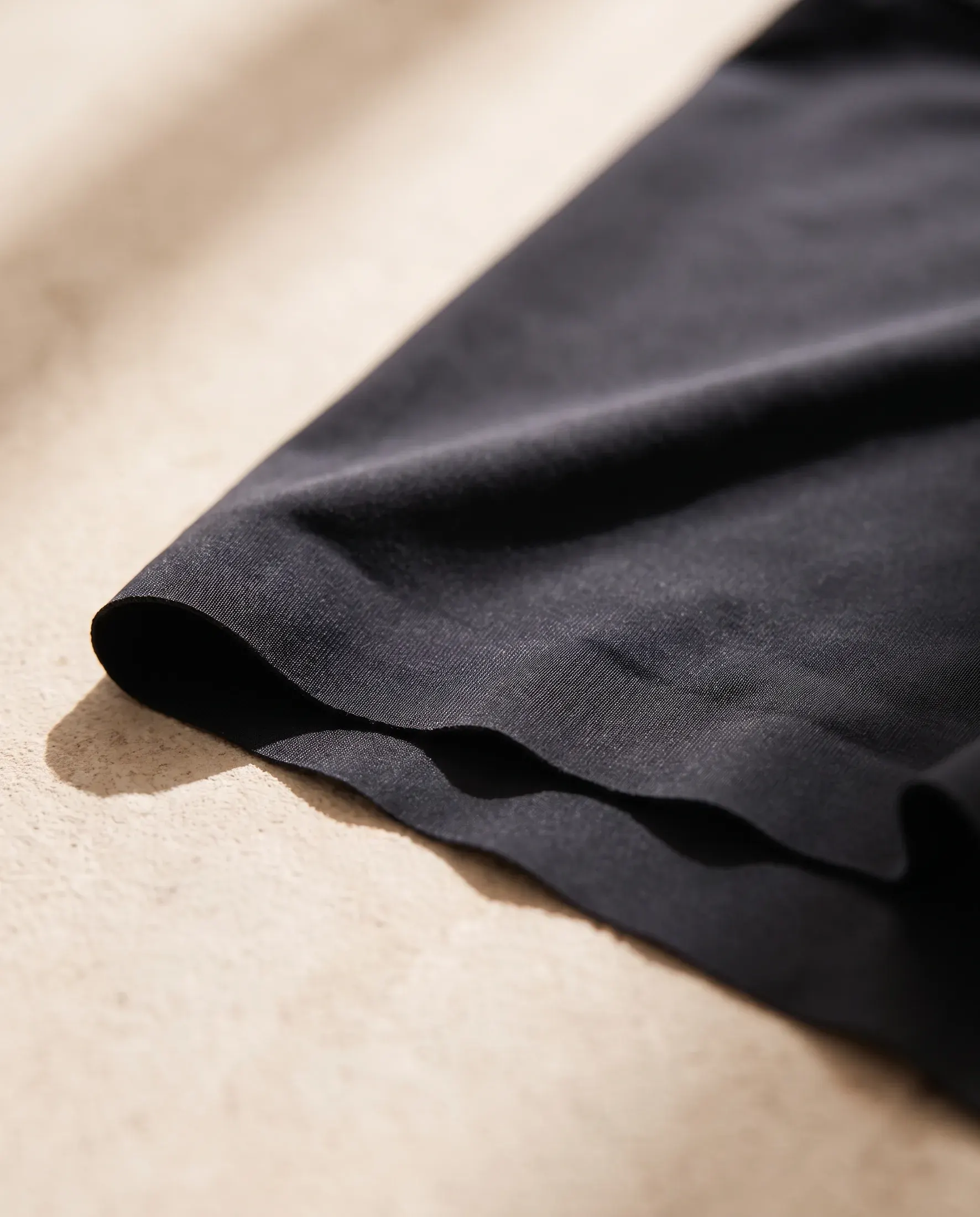
Fabric decides whether the fit you had at 8am still exists at 6pm. A knit with good recovery returns to shape after every stretch; a knit without it stays stretched, and the slack collects at the top of the thigh where it bunches and climbs.
Elastane content is the usual shorthand for recovery, but it is only half the story — the knit structure and the quality of the yarn matter too. In practice, fine synthetic knits with elastane hold a close fit through a day more consistently than heavier cotton jersey, which absorbs moisture, warms up and relaxes.
That is a trade-off, not a verdict. Cotton feels different against skin and many men prefer it. Our guide comparing microfibre and cotton goes through what each one gives up.
What to look for when you buy
Buy for hem position first, fabric recovery second and hem construction third. Those three, in that order, decide whether a pair stays where you put it.
- A leg that finishes below the widest part of your thigh when you are standing.
- A fine knit with elastane, described in terms of recovery rather than just stretch.
- A flat, bonded or knitted-in leg hem — no narrow elastic band sewn on the inside.
- A size chosen from a tape measure at the waist, not from your trouser size.
- A return policy that lets you test a single pair before you commit to a drawer full.
Frequently asked questions
Why does my underwear always ride up?
Almost always because the leg hem sits above the widest part of your thigh, so each stride pushes it further up a narrowing leg. Fabric that stretches without recovering and a narrow elastic hem that rolls make it faster, but hem position is the root cause.
What underwear doesn’t ride up on thick thighs?
A longer-leg boxer brief in a fine knit with a flat hem, sized from your waist measurement. Briefs are the other reliable answer, because a garment with no leg cannot migrate — at the cost of no thigh coverage at all.
Will sizing up stop my boxer briefs riding up?
Usually not. A bigger size has a looser leg opening and less grip, so it tends to move more. Size up only if the current pair is genuinely too tight — digging waistband, strained seams, deep marks on the skin.
Do boxer briefs ride up more than trunks?
Less often, because their longer leg is more likely to finish below the widest part of the thigh. A trunk’s short leg frequently lands above it, which is the exact position that migrates.
Does the fabric really make a difference?
Yes, over a day. A knit with poor recovery stays stretched after it moves, and that slack gathers at the top of the thigh. The same cut in a fine knit with good recovery holds its position much longer.
Can any underwear guarantee it will never ride up?
No, and you should be sceptical of brands that say so. Thigh shape varies enormously between bodies. The honest version is that the right leg length, fabric and hem make it far less likely — which is what we design for.
Where these numbers come from
- Mechanism
- The hem-position explanation is geometry — a band above the widest point of a tapering thigh has no stable seat — plus standard knit-recovery behaviour. It is reasoning from how the garment and the leg are shaped, not a study.
- Our own product
- The Everyday Brief is in development and has not been wear-tested. Nothing here is a performance claim about it, and we do not claim it never rides up.
The product behind these guides
The Everyday Brief
Low-rise, no-fly, black, sizes S–XXL. In development — the specs we’ve confirmed and the ones we haven’t are listed on the product page.
Want to know when it’s real?
We’ll email you once, when The Everyday Brief goes on sale. Nothing else.