Fabric & construction
Moisture-wicking underwear: what the word actually means
Key takeaways
- Wicking is capillary action: liquid moves along and between fibres to the surface, where it can evaporate. It is a property of the fibre and knit, not a coating someone sprays on.
- Synthetics wick because they barely absorb water — polyester holds under 1% of its weight, so sweat travels along the fibre instead of soaking into it.
- Cotton does the opposite: it absorbs up to about a quarter of its weight in water and holds it against the skin, which is why a cotton pair feels heavy hours after you stop sweating.
- No underwear stops you sweating. Wicking changes where the sweat goes and how fast it dries — that is the whole mechanism.
- “Moisture-wicking” is an unregulated marketing term. A brand that cannot name the fibre, the knit and the weight is describing a feeling, not a fabric.
- FEELAFTER makes no wicking claim: we have not run moisture-transport testing on our own fabric, and we will publish the method alongside any number we eventually quote.
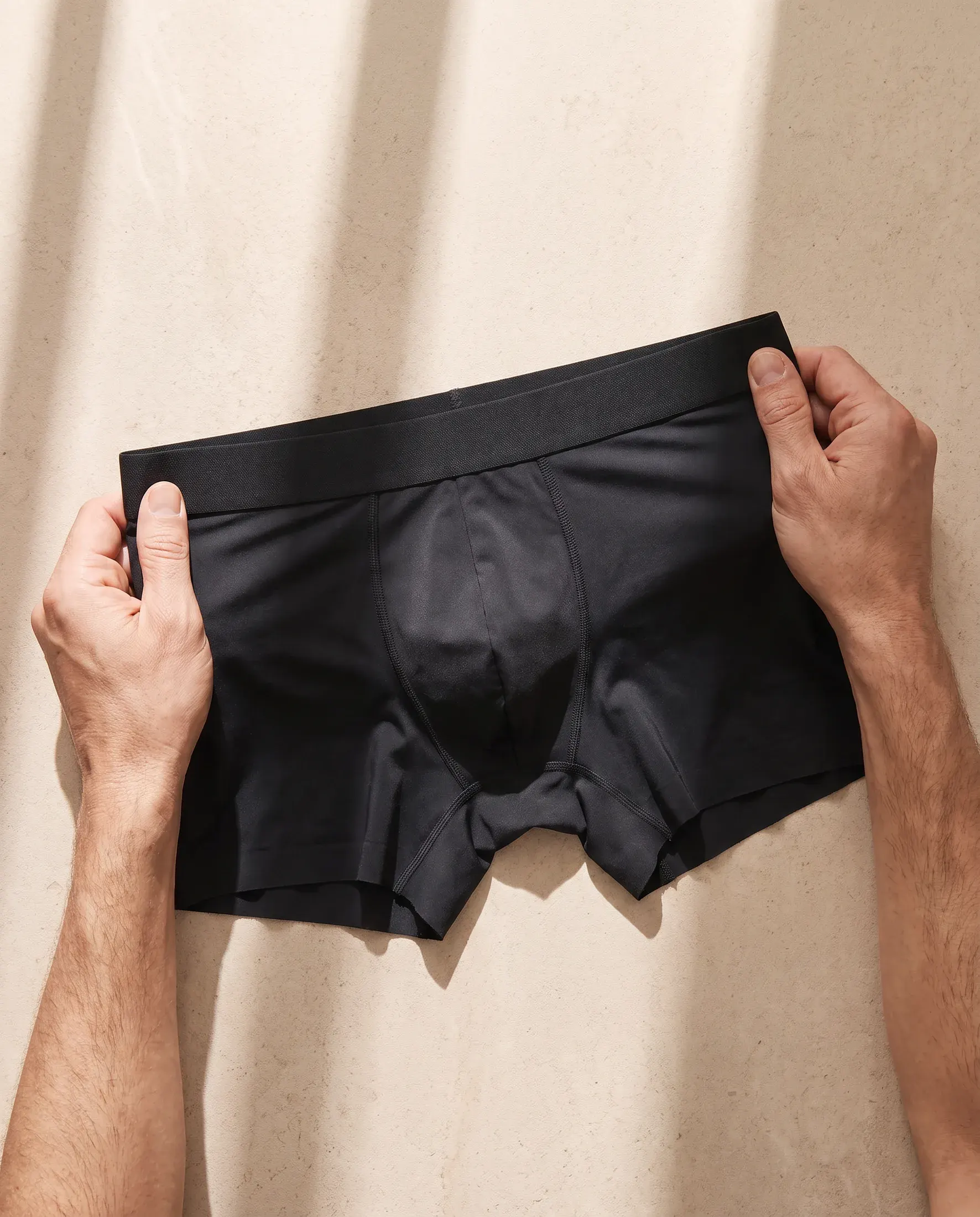
What does moisture-wicking actually mean?
Moisture-wicking means the fabric moves liquid sweat away from your skin by capillary action, spreading it across a wider surface where it evaporates faster. It is a physical property of the fibre and the knit structure — not a chemical treatment and not a guarantee of dryness.
Picture water climbing up a paper towel. The same forces operate between the filaments of a fine synthetic knit: narrow channels pull liquid along them. A fabric that wicks well keeps that liquid moving outward, to the face of the fabric, where air can reach it.
That is why wicking and absorbency are opposites rather than partners. A fibre that soaks water into itself has nothing left to transport. A fibre that repels water keeps it on the surface, free to travel and evaporate.
| Fibre | How much water it absorbs | What that means on the body |
|---|---|---|
| Polyester | Under ~1% of its weight | Barely absorbs; sweat travels and evaporates fast |
| Nylon (polyamide) | Around 4% | Slightly more absorbent, still fast-drying; tough |
| Merino wool | Up to ~30%, but into the fibre core | Feels dry while holding moisture; resists odour |
| Cotton | Around 25% | Soaks and holds against the skin; slow to dry |
| Modal / viscose | Higher than cotton | Very soft, stays wet longer than cotton |
Will it stop you sweating?
No. Sweating is thermoregulation, and no garment prevents it. What wicking fabric changes is the aftermath: sweat spreads and evaporates rather than pooling, so you spend less of the day in contact with wet fabric.
This matters because damp fabric is the thing that causes the problems people actually complain about. Wet skin abrades far more easily than dry skin, which is the mechanism behind most chafing, and a warm damp layer is a comfortable environment for the bacteria that produce odour.
How to tell a real claim from marketing
Ask what the fabric is. A brand that states fibre, blend, knit and weight is describing something testable; a brand that only offers adjectives is selling a feeling.
| What the page says | What to ask | A good answer looks like |
|---|---|---|
| “Moisture-wicking technology” | Which fibre and knit? | “88% polyester, 12% elastane, fine jersey knit” |
| “Keeps you dry all day” | Tested how? | A drying-rate or moisture-transport test with a method |
| “Breathable” | What weight? | A stated GSM — lighter knits move air better |
| “Anti-odour” | Fibre or treatment? | Merino, or a named treatment with wash durability |
| “Quick-dry” | How quick, from what? | A time, from a stated saturation level |
Most brands cannot answer these, and that is informative. The ones that can are usually the ones worth buying from.
What to wear when you sweat
For heat, distance or long days, wear a fine synthetic knit with elastane, in a cut that covers where your thighs touch. For odour resistance across multiple wears, merino is the natural alternative — at the cost of durability.
- Fine polyester or nylon with elastane: the best-drying, longest-lasting option, and the worst for odour between washes.
- Merino: dries well and resists odour longest, but wears through faster and costs more.
- Blends of synthetic with a little natural fibre: a middle ground, usually closer to the synthetic in behaviour.
- Cotton: comfortable until you sweat, then the worst choice on this list.
Coverage matters as much as fabric. A wicking fabric cannot help skin it does not cover, which is why our chafing guide starts with leg length rather than fibre.
What we claim, and what we don’t
We do not claim moisture-wicking performance for The Everyday Brief, because we have not tested it. We are developing a fine synthetic knit, which is the fibre family that wicks — but a fibre family is not a test result.
The benchmark garment we develop against is labelled 88–89% polyester with 11–12% elastane. That tells you the material class we are working in. It tells you nothing about how our fabric performs, and we would rather say so than borrow someone else’s reputation.
Frequently asked questions
What does moisture-wicking mean in underwear?
It means the fabric moves liquid sweat away from your skin by capillary action and spreads it so it evaporates faster. It is a property of the fibre and knit structure, not a chemical coating, and it does not stop you sweating.
Are there boxer briefs that don't make you sweat?
No. Sweating is how your body regulates temperature, and no fabric prevents it. A fine synthetic knit changes what happens next — sweat spreads and dries instead of sitting against your skin.
What underwear is best for hot weather?
A lightweight synthetic knit with elastane, cut long enough in the leg to cover where your thighs touch. Merino is the natural alternative if odour between washes matters more to you than durability.
Does moisture-wicking underwear actually work?
The mechanism is real and well understood — synthetics genuinely move and release moisture far faster than cotton. Whether a specific product performs well depends on its knit and weight, which most brands do not disclose.
Is moisture-wicking the same as breathable?
No. Breathability is about air and vapour passing through the fabric; wicking is about liquid moving along it. A dense synthetic can wick well and breathe poorly. Both are affected more by knit and weight than by the fibre name.
Why does wicking underwear still smell?
Because polyester holds the oily compounds that bacteria turn into odour more stubbornly than cotton does. Wash after every wear, skip fabric softener, and use a full detergent dose. It is the trade-off synthetics make.
Where these numbers come from
- Moisture regain figures
- Approximate published moisture-regain values for raw fibres, standard across textile references. Finished fabric behaviour varies with knit, weight and finishing.
- FEELAFTER fabric
- No moisture-transport, drying-rate or thermal testing has been performed on our fabric. No wicking claim is made anywhere on this site.
The product behind these guides
The Everyday Brief
Low-rise, no-fly, black, sizes S–XXL. In development — the specs we’ve confirmed and the ones we haven’t are listed on the product page.
Want to know when it’s real?
We’ll email you once, when The Everyday Brief goes on sale. Nothing else.