Comparison
Boxer briefs vs trunks vs briefs: which cut actually suits you
Key takeaways
- A trunk is a boxer brief with a shorter leg. The pattern is the same; the difference is roughly two to three inches of fabric on the thigh.
- Leg length decides more than any other measurement: a hem that sits below the widest part of your thigh tends to stay put, and a hem that sits above it tends to climb.
- Briefs have no leg at all, so they cannot ride up — which is why they remain the default for men whose thighs make every legged cut migrate.
- Rise controls where the waistband sits, not how tight it is. Low rise sits on the hips and disappears under low-cut trousers; regular rise sits nearer the navel.
- Cotton stretches as it warms and holds moisture, so the same cut can ride up in cotton and stay put in a fine synthetic knit.
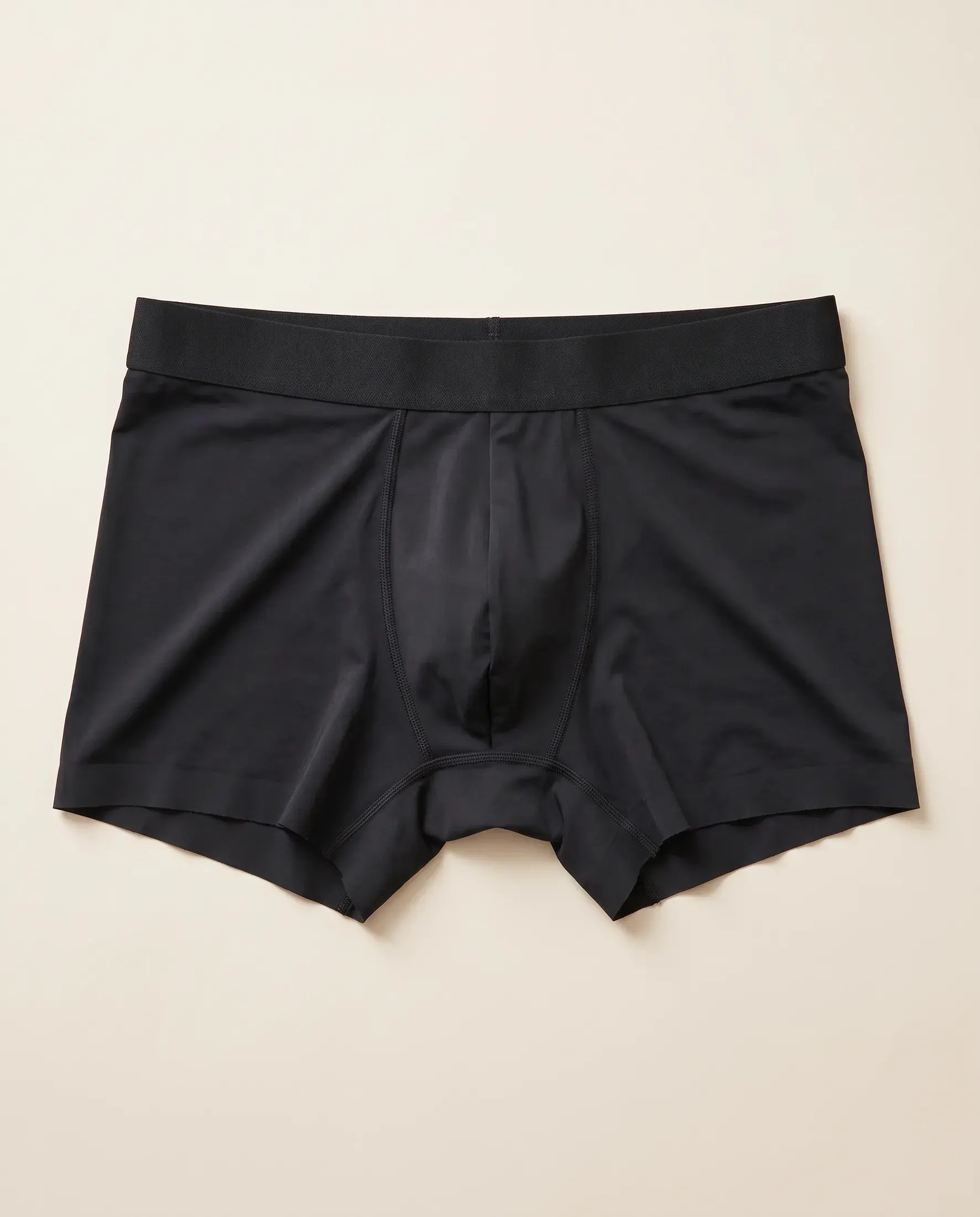
- The Everyday Brief is a low-rise, no-fly, short-leg boxer brief in black. It is in development, and the measured size chart is not final.
What is the difference between boxer briefs, trunks and briefs?
Boxer briefs, trunks and briefs are the same basic garment at three leg lengths: a boxer brief has a leg of roughly four to six inches, a trunk shortens that leg to about two to three inches, and a brief removes the leg entirely. Boxers are the outlier — a loose, woven short with no close fit anywhere.
Brands do not agree on these numbers, and the same label will vary between styles, so treat the table below as the typical retail range rather than a standard. The useful part is the order: brief, trunk, boxer brief, boxer.
| Cut | Leg length (typical) | Rise | What it does well | Most common complaint |
|---|---|---|---|---|
| Brief | None | Low to regular | Nothing to ride up; least fabric; invisible under slim trousers | No thigh coverage, so skin-on-skin contact stays |
| Trunk | ~2–3 in | Usually low | Square shape, short profile, works on shorter legs | Hem can sit above the widest part of the thigh and climb |
| Boxer brief | ~4–6 in | Low to regular | Thigh coverage that stops skin-on-skin rubbing | More fabric to bunch if the knit has no recovery |
| Boxer (woven) | ~5–8 in, loose | Regular | Airflow, no compression anywhere | Bunches under trousers; no support; fabric shifts all day |
Which cut rides up the least?
Briefs ride up least because there is no leg to move. Among legged cuts, the one that stays put is the one whose hem finishes below the widest part of your thigh in a fabric with enough recovery to hold there — usually a boxer brief rather than a trunk.
Riding up is a mechanical problem, not a quality problem. A leg hem that stops above the thigh’s widest point has nowhere to go but up each time you walk, and a hem that stops below it is effectively wedged in place. That is why two pairs of the same size from the same brand can behave differently: one is a trunk and one is a boxer brief.
- Leg length relative to your thigh — the single biggest factor.
- Fabric recovery — whether the knit returns to shape after it stretches, or stays stretched and loose.
- Hem construction — a flat bonded or knitted-in hem grips more evenly than a tight elastic band, which can roll.
- Fit through the seat — a pair that is too small pulls the leg up from above, no matter how long it is.
We cover the causes and the fixes in more detail in our guide to underwear that rides up.
Which cut works under which clothes?
Under slim or low-rise trousers, a low-rise brief or trunk avoids a waistband above the trouser line. Under a suit or anything light-coloured, a short, smooth, seam-light cut in a fine knit shows the least. Under shorts in heat, thigh coverage matters more than profile.
| What you’re wearing | Cut that usually works | Why |
|---|---|---|
| Slim or low-rise trousers | Low-rise trunk or boxer brief | Waistband stays under the trouser band |
| Suit trousers, light colours | Fine-knit boxer brief, flat hems | Smooth surface, fewer edges to print through |
| Shorts in heat | Boxer brief | Thigh coverage stops skin-on-skin contact |
| Gym or running | Boxer brief in a synthetic knit | Coverage plus a fabric that moves moisture |
| Loose or traditional trousers | Brief or boxer | Nothing to bunch; airflow |
What does low rise actually change?
Rise is the distance from the crotch seam to the top of the waistband, so it sets how high the band sits — not how tight it is. A low rise sits on the hips, below the navel, which keeps it under the waistband of modern trousers.
Men often read low rise as “tighter” or “smaller”. It is neither. A low-rise pair in your size has the same waistband circumference as a regular-rise pair in your size; it simply starts lower on the body. If you wear trousers that sit on the hips, a regular rise is the thing that bunches at the front when you sit down.
- Stand up and find where your trouser waistband sits.
- If it sits on your hip bones, choose low rise.
- If it sits at or above the navel, regular rise will stay hidden and feel more secure.
Which cut we chose for The Everyday Brief, and why
The Everyday Brief is a low-rise, no-fly boxer brief with a short leg — the combination that removes the three things men complain about most: a waistband above the trouser line, a fly that adds bulk at the front, and a leg hem that climbs.
We are an independent brand and the product is still in development. What is decided: the silhouette, the colour (black first), and five planned sizes from S to XXL. What is not: the final fabric composition, the measured size chart and the exact leg length. We publish both lists on the product page rather than implying the spec sheet is finished.
How to choose in under a minute
Start from the problem you actually have — riding up, visible waistband, heat, or bunching — and let it pick the cut. Preference only matters after the mechanical problem is solved.
| If your problem is… | Try | Instead of |
|---|---|---|
| The leg climbs within an hour | A longer-leg boxer brief in a fine synthetic knit | A cotton trunk |
| Skin rubs on long, hot days | A boxer brief with thigh coverage | Briefs or boxers |
| Waistband shows above your trousers | Low rise | Regular rise |
| Fabric bunches at the front when seated | A no-fly front | A fly opening with layered panels |
| Lines print through light trousers | Flat or bonded hems, fine knit | Thick elastic hems, ribbed cotton |
Frequently asked questions
Which is better, trunks or boxer briefs?
Neither is better in general. Trunks suit shorter legs and anyone who dislikes fabric on the thigh; boxer briefs suit longer legs and anyone whose thighs rub. If your underwear rides up, the boxer brief is usually the fix, because its hem finishes below the widest part of the thigh.
Are trunks tighter than boxer briefs?
No. A trunk in your size has the same waist and seat measurements as a boxer brief in your size from the same brand — it just has a shorter leg. Trunks can feel tighter on the thigh because the hem sits on a wider part of the leg.
What is the difference between low-rise trunks and boxer briefs?
Two things: leg length and rise. A low-rise trunk has a short leg and a waistband that sits on the hips. A boxer brief has a longer leg and may be low or regular rise. Low-rise boxer briefs, like the one we are developing, combine both.
Is it healthier to wear boxers or boxer briefs?
We do not make health claims. Published research on underwear type and fertility is mixed, and we have run no studies of our own. If you have a medical concern, ask a doctor rather than an underwear brand.
Do boxer briefs bunch up more than trunks?
They can, because there is more fabric. Bunching is mostly a fabric problem: a knit with poor recovery stays stretched after it moves, and the excess gathers. A fine knit with good recovery in the right size bunches far less than a loose cotton one, whatever the leg length.
What cut is best under slim trousers?
A low-rise cut in a fine knit with flat hems. The waistband stays under the trouser band, and a smooth fabric with bonded or knitted-in edges leaves the fewest lines to print through light fabric.
Where these numbers come from
- Leg length and rise ranges
- Typical ranges as labelled across mainstream retail styles, not an industry standard. Individual brands publish their own measurements and they vary.
- The Everyday Brief specifications
- Silhouette, colour and planned size range are confirmed. Fabric composition, measured chart and inseam are in development and marked as unconfirmed everywhere they appear.
The product behind these guides
The Everyday Brief
Low-rise, no-fly, black, sizes S–XXL. In development — the specs we’ve confirmed and the ones we haven’t are listed on the product page.
Want to know when it’s real?
We’ll email you once, when The Everyday Brief goes on sale. Nothing else.