Fabric & construction
Microfibre vs cotton underwear: what each one actually gives up
Key takeaways
- Microfibre is not a material — it is a fibre fineness. Most microfibre underwear is polyester or nylon knitted from very fine filaments, usually with elastane for stretch.
- The core trade-off: synthetics move moisture along the fibre and dry quickly, while cotton absorbs moisture into the fibre and holds it.
- Cotton is more comfortable than a synthetic while it is dry, and less comfortable than a synthetic once it is wet.
- Odour is the price of synthetics. Polyester holds the compounds that cause smell more stubbornly than cotton does, which is why washing routine matters more with it.
- “Breathable” usually describes airflow, but what you feel is moisture management — a fine synthetic knit can feel cooler than a thick cotton one despite being plastic.
- The benchmark garment behind our own product is labelled 88–89% polyester with 11–12% elastane, and we have published the full label transcription.
What is microfibre underwear?
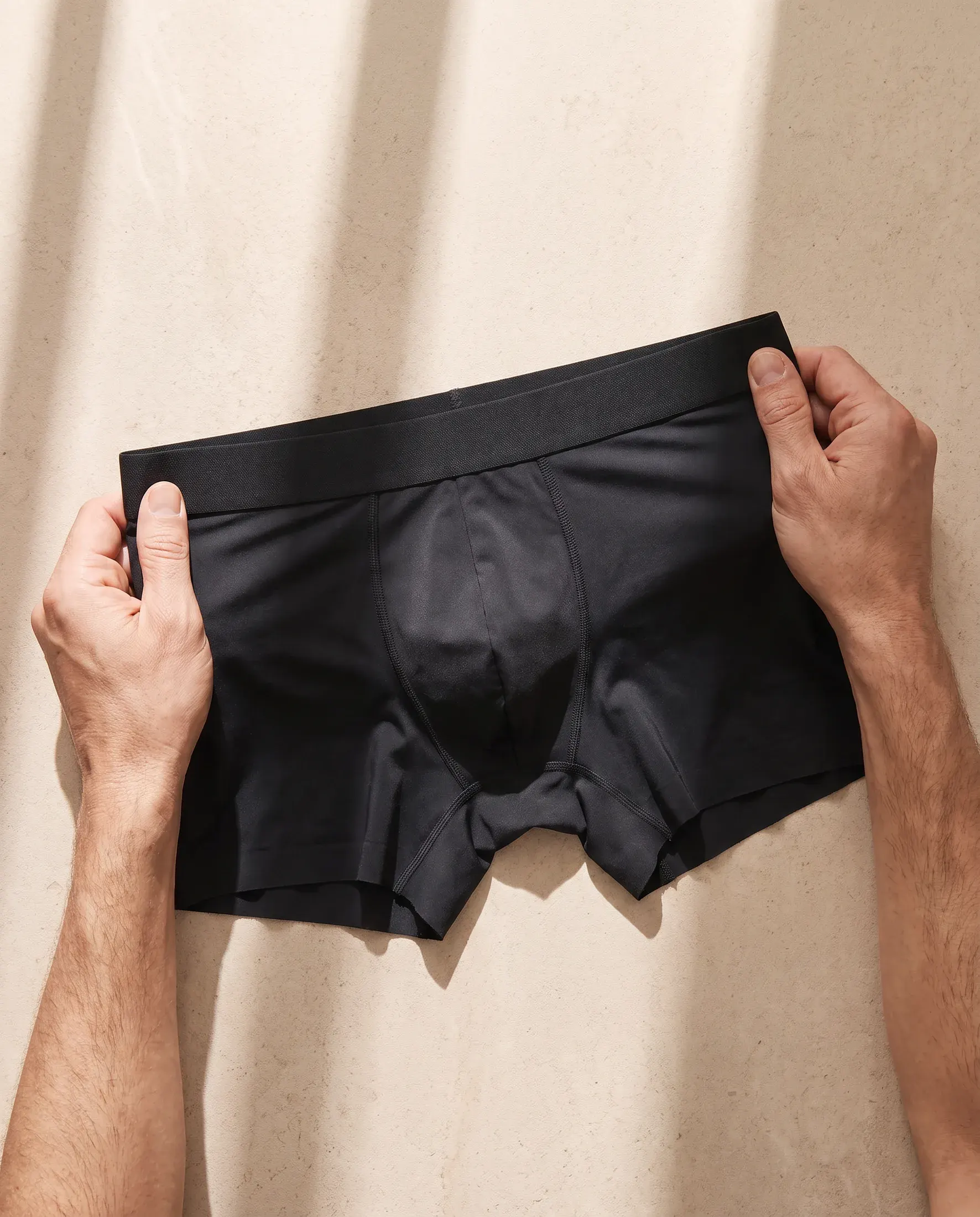
Microfibre describes a fibre finer than one denier — roughly finer than a strand of silk — not a specific material. In underwear it almost always means polyester or nylon filaments knitted into a smooth, light fabric, usually blended with elastane so it stretches and recovers.
That fineness is what produces the hand-feel people describe as slippery, smooth or “barely there”. More filaments per thread means a softer surface and more surface area, which is also why these fabrics move moisture so effectively.
| Term on the label | What it actually is | What it does |
|---|---|---|
| Microfibre | Fibre fineness, usually polyester or nylon | Smooth surface, light weight, fast moisture spread |
| Polyester | The most common synthetic fibre | Durable, quick-drying, holds odour |
| Nylon (polyamide) | Stronger, slightly softer synthetic | Abrasion resistance; common in waistbands |
| Elastane / spandex / Lycra | The stretch fibre, typically 5–15% | Stretch and recovery — the fit holding all day |
| Modal / TENCEL | Regenerated cellulose | Soft like cotton, drapes more, dries faster than cotton |
Microfibre vs cotton, side by side
Microfibre wins on drying speed, weight, fit retention and performance when you sweat. Cotton wins on dry comfort, odour resistance between washes and the feel most men grew up with.
| Microfibre (polyester/nylon) | Cotton | |
|---|---|---|
| Moisture | Moves it along the fibre to the surface | Absorbs it into the fibre and holds it |
| Drying time | Fast — often an hour or two on a line | Slow — can stay damp all day against skin |
| Feel when dry | Smooth, light, slippery | Soft, familiar, warmer |
| Feel when wet | Stays light; keeps moving moisture | Heavy, cold, clingy, rough at seams |
| Odour between washes | Holds odour more stubbornly | Releases odour more readily |
| Fit over a day | Holds shape when blended with elastane | Warms, relaxes and loosens |
| Durability | High; resists abrasion | Moderate; thins with washing |
| Hot weather | Generally the better option | Comfortable until you sweat |
| Travel | Washes in a sink, dries overnight | Rarely dries overnight |
Is microfibre underwear bad for you?
There is no good evidence that wearing polyester or nylon underwear is harmful to healthy skin. The practical complaints are odour retention and, for some people, irritation when a synthetic traps sweat against skin for long periods — both of which are about moisture and hygiene rather than the fibre itself.
We are an underwear brand, not a medical authority, so here is the honest boundary: if you have persistent irritation, recurrent rashes or a diagnosed skin condition, that is a question for a doctor, and the answer may well be that a particular fabric does not suit you. What we can speak to is the mechanism — damp fabric held against skin for hours is the thing that causes problems, and a fabric that dries faster spends less time damp.
- Change out of damp underwear rather than letting it dry on you.
- Wash synthetics after every wear; they do not get a second day the way cotton sometimes does.
- Skip fabric softener on synthetics — it coats the fibres and makes odour worse.
- If a specific fabric consistently irritates your skin, stop wearing it and ask a doctor rather than pushing through.
There is a separate environmental question about synthetic microfibres shedding in the wash. It is real, it applies to all synthetic textiles, and a wash bag designed to catch fibres is the usual mitigation. We would rather name it than pretend it is not part of choosing these fabrics.
Is microfibre breathable?
Breathability and moisture management are two different things, and what you feel is mostly the second one. A fine synthetic knit does not absorb sweat, it spreads it thin so it evaporates — which can feel cooler than a thicker cotton fabric that soaks it up.
Knit structure matters more than the fibre name here. An open, fine knit in polyester will breathe better than a dense one, and a dense cotton jersey will feel hotter than a light cotton voile. Marketing language flattens all of this into one word, so look at weight and knit rather than the claim.
Which should you buy?
Choose by the hardest day you expect that pair to handle. If your day involves heat, distance, travel or sweat, a fine synthetic knit is the better tool. If your day is short, cool and mostly seated, cotton is a perfectly good choice.
| Your day | Better choice | Why |
|---|---|---|
| Office, cool climate | Either | Moisture never becomes the limiting factor |
| Hot and humid | Fine synthetic | Dries as fast as you sweat |
| Long flights, travel | Fine synthetic | Sink-washable, dries overnight, packs small |
| Gym, running, hiking | Fine synthetic or merino | Moisture control plus coverage |
| Sensitive skin, short days | Cotton or modal | Soft when dry; change if it gets damp |
| Sleeping | Cotton or nothing | No moisture load; comfort is the only criterion |
The Everyday Brief is being developed as a fine synthetic knit, benchmarked against a garment labelled 88–89% polyester with 11–12% elastane. Our own composition is not final, and we publish it as unconfirmed until it is.
Frequently asked questions
Is microfibre underwear bad for you?
There is no good evidence that it harms healthy skin. The real issues are odour retention and irritation when damp fabric sits against skin for hours. Change out of damp pairs, wash synthetics every wear, and see a doctor about persistent irritation.
Is microfibre or cotton better for underwear?
Microfibre is better when sweat, heat, travel or long days are involved, because it dries fast and keeps its fit. Cotton is better for short, cool days where dry comfort is the only thing that matters. Neither wins outright.
Is microfibre underwear breathable?
Fine synthetic knits manage moisture well, which is what most people mean by breathable. They do not absorb sweat; they spread it so it evaporates. A light, open knit breathes better than a dense one regardless of the fibre.
Why does my polyester underwear smell?
Polyester holds the oily compounds that bacteria turn into odour more stubbornly than cotton. Wash after every wear, skip fabric softener, and use a proper detergent dose. Odour that survives washing usually means residue built up in the fabric.
What is the best underwear fabric for hot weather?
A fine synthetic knit with elastane, or merino if you prefer a natural fibre and accept shorter lifespan. Both keep moving moisture once you are sweating, which is the point at which cotton starts working against you.
What is FEELAFTER’s fabric?
Not finalised. We are developing a fine synthetic knit against a benchmark garment whose label reads 88–89% polyester with 11–12% elastane in the body and 90% nylon with 10% elastane in the waistband. Our verified composition will be published before we take orders.
Where these numbers come from
- Benchmark composition
- Transcribed from the packaging of two UNIQLO AIRism low-rise boxer briefs bought in Vietnam, September 2026. Full transcription in our benchmark guide.
- Fabric behaviour
- General textile behaviour — absorption versus wicking, drying rate, odour retention in polyester — is long-established and not specific to any brand. We have run no tests of our own and cite none.
The product behind these guides
The Everyday Brief
Low-rise, no-fly, black, sizes S–XXL. In development — the specs we’ve confirmed and the ones we haven’t are listed on the product page.
Want to know when it’s real?
We’ll email you once, when The Everyday Brief goes on sale. Nothing else.