Fabric & construction
Seamless underwear: what it means, and what it doesn’t
Key takeaways
- Most underwear sold as “seamless” has seams. The word usually means the seams are bonded or flattened so they do not print through clothing.
- There are three different constructions hiding behind one word: knitted in the round with almost no seams, bonded with adhesive, and flatlock stitched.
- Seamless solves two distinct problems — visible lines under clothes, and seams rubbing your skin — and the right construction differs for each.
- The leg hem matters more than the seams for visible lines: a thick elastic hem prints through trousers that a flat bonded edge would not.
- Bonded seams are the smoothest and the least durable; flatlock seams last longest and are slightly more visible.
- The Everyday Brief uses flat-finished edges and a no-fly front to reduce layers, which is a construction decision we can describe rather than a performance claim.
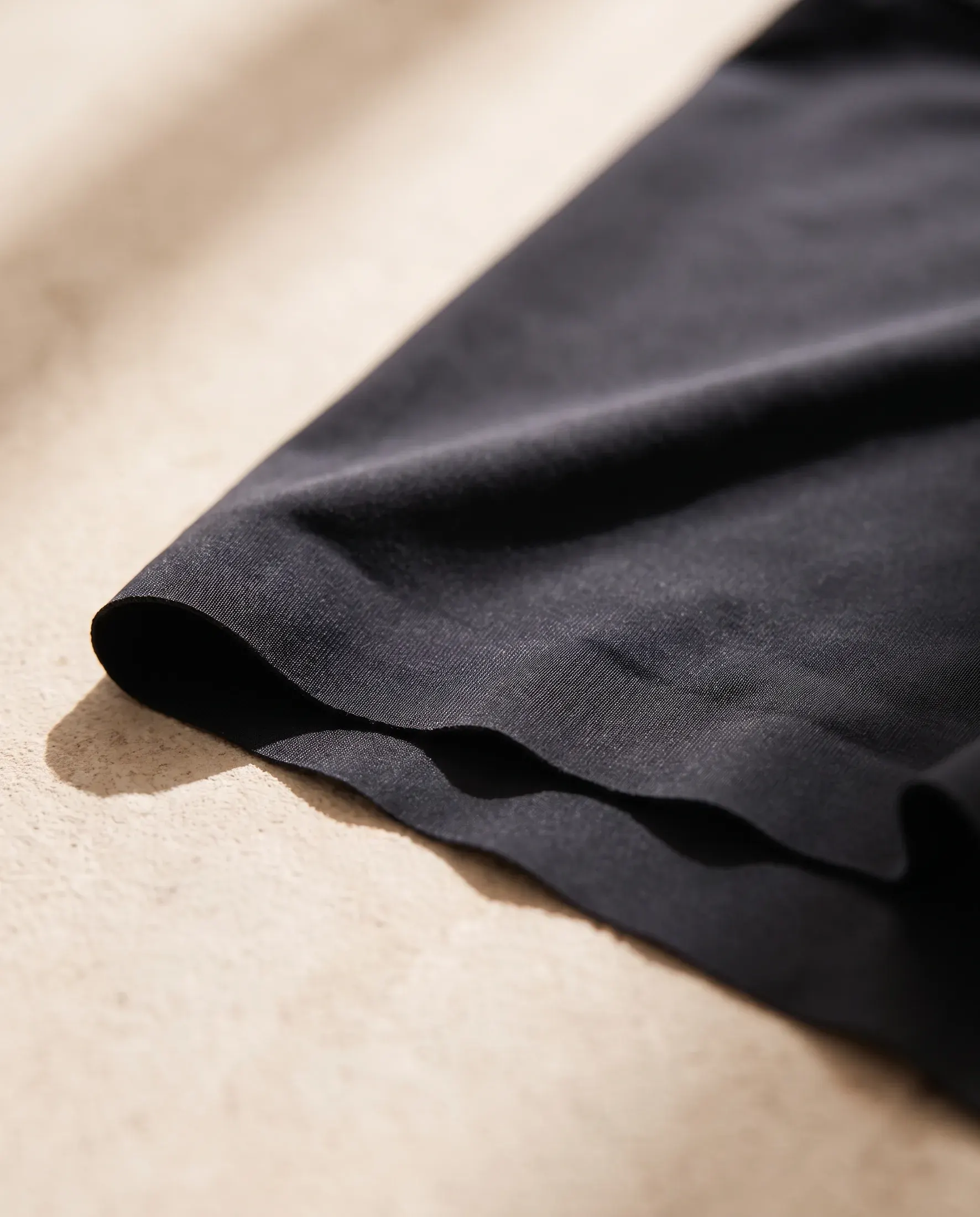
What is seamless underwear?
“Seamless” almost never means a garment with no seams. In practice it means the seams have been made invisible or imperceptible — bonded with adhesive, flattened with a flatlock stitch, or knitted in a way that eliminates side seams.
It is a description of finishing, not of the pattern. Somewhere on that garment two pieces of fabric were joined, unless it was knitted as a tube — and even then the gusset is sewn in.
| Construction | How it's made | Feels like | Durability |
|---|---|---|---|
| Knitted in the round | Tube-knitted so there are no side seams at all | The smoothest; almost nothing to feel | Good, though the knit is often thinner |
| Bonded / welded | Edges glued with heat and adhesive tape | Completely flat; no stitch texture | Weakest — bonds can lift after many washes |
| Flatlock stitched | Edges butted together and stitched flat | A slight ridge you can feel but rarely see | Strongest of the three |
| Conventional overlock | Edges folded and stitched (not “seamless”) | A raised ridge, the classic seam | Strong; most likely to print through |
Which problem are you actually solving?
Two different problems get the same answer sold to them. If you are trying to hide lines under trousers, you need flat edges and a fine knit. If seams rub you, you need seam placement away from the contact area — which is a pattern question, not a finishing one.
| Your problem | What fixes it | What won't |
|---|---|---|
| Lines showing through light trousers | Flat bonded or knitted-in hems, fine knit | A “seamless” label on a thick fabric |
| A seam rubs the inner thigh | Different seam placement, or a longer leg | Bonding the same seam in the same place |
| Waistband prints through | A wide, flat knitted band | Seam finishing anywhere else |
| Ridge across the seat | Flatlock or bonded back seam | Overlocked construction |
| Hem leaves a mark on the thigh | A wider, softer hem, or a larger size | Any seam treatment |
If your problem is the hem digging in or riding up, that is a fit and cut question rather than a seam question — our guide on why underwear rides up covers the four causes.
What you give up
Bonded seams are the smoothest and the first to fail: adhesive bonds lift with heat, agitation and time, and a lifted bond cannot be repaired. Knitted-in-the-round garments are usually thinner. Flatlock lasts longest but you can feel it.
- Wash bonded garments cool and skip the tumble dryer — heat is what breaks adhesive down.
- Expect a bonded pair to have a shorter life than a flatlock pair of the same quality.
- Judge after ten washes, not on day one: smoothness is obvious immediately, failure is not.
- A thin “seamless” knit can be more transparent than a conventional one — check it in daylight before buying five.
How The Everyday Brief is built
Flat-finished leg edges, a no-fly contoured front to remove layers where they print through most, and a wide flat knitted waistband. These are construction choices we can state plainly — none of them is a claim about performance.
We are not calling it seamless, because it has seams. What we can say is where they are and why: a front with no fly opening removes two to four overlapping layers from the exact spot that shows under tailored trousers.
Frequently asked questions
What is seamless underwear?
Underwear whose seams have been made invisible or imperceptible — bonded with adhesive, stitched flat, or knitted in the round to avoid side seams. It rarely means a garment with literally no seams.
Is seamless underwear better?
Better at hiding lines under close-fitting clothes, yes. Not automatically better to wear: bonded seams are the smoothest and the least durable, and a thin seamless knit can be less opaque than a conventional one.
How do I stop underwear lines showing through trousers?
Choose flat or bonded hems over thick elastic ones, a fine knit over a ribbed one, and a cut whose leg ends where your trousers are loose rather than tight. Colour matters too — match your skin tone rather than your trousers under light fabrics.
What is the difference between bonded and flatlock seams?
Bonded seams are glued with heat and adhesive tape, leaving a completely flat join that eventually lifts. Flatlock seams are stitched with the edges butted together, leaving a slight ridge that lasts much longer.
Is FEELAFTER's Everyday Brief seamless?
No, and we do not describe it that way. It has flat-finished edges and a no-fly front that removes layers at the point where underwear most often prints through, but it has seams like nearly every garment sold as seamless.
Where these numbers come from
- Construction descriptions
- General garment-construction practice across the underwear category, not specific to any brand. Durability comparisons reflect how these seam types behave in normal laundering rather than a controlled wash test.
The product behind these guides
The Everyday Brief
Low-rise, no-fly, black, sizes S–XXL. In development — the specs we’ve confirmed and the ones we haven’t are listed on the product page.
Want to know when it’s real?
We’ll email you once, when The Everyday Brief goes on sale. Nothing else.