Fit & sizing
No-fly boxer briefs: why the opening disappeared, and who should care
Key takeaways
- A no-fly front replaces the overlapping opening with a single shaped panel, which removes two to four layers of fabric and at least one seam from the front of the garment.
- The trade-off is simple: less bulk and fewer pressure points against convenience at a urinal.
- Most men who switch report using the waistband instead of the fly, which is why the feature disappears without much protest.
- A fly is a construction decision, not a quality signal — plenty of expensive underwear has none, and plenty of cheap underwear has one.
- If you wear suits, cycle, or sit for long stretches, the flatter front is the part you will notice.
- The Everyday Brief is no-fly by design, for the same reason: fewer layers where the garment presses against you.
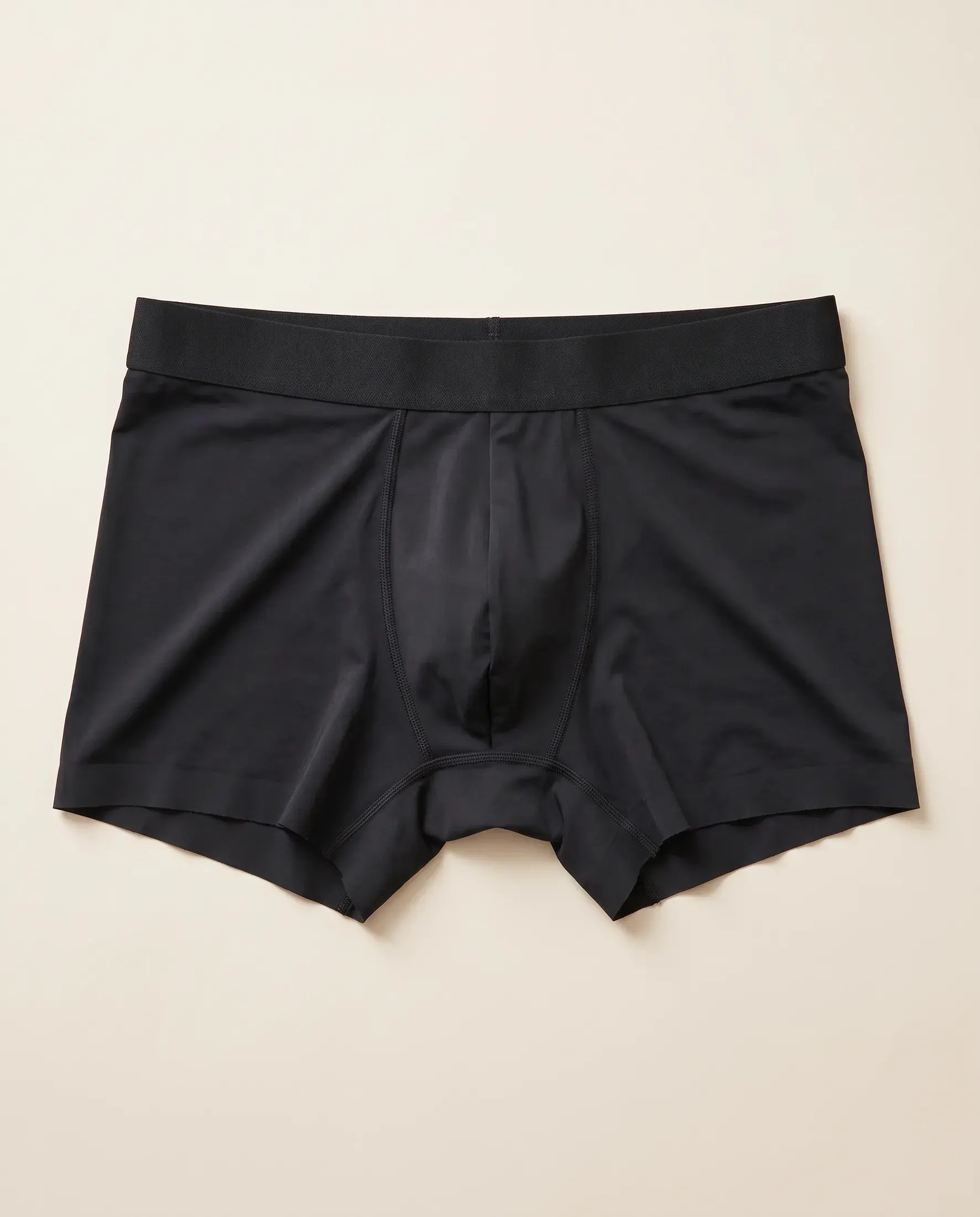
What is a no-fly boxer brief?
A no-fly boxer brief has no opening at the front. Instead of two overlapping panels forming a vertical or horizontal slot, the front is one shaped piece — usually with a contoured seam that creates room without adding layers.
| Front type | Layers at the front | Practical effect |
|---|---|---|
| Vertical fly (traditional) | 3–4 overlapping | Bulkiest; the classic, familiar option |
| Horizontal fly | 2–3 overlapping | Less bulk than vertical; still an opening |
| Contour pouch, no fly | 1–2 shaped panels | Flattest front; shape comes from the pattern |
| No fly, flat front | 1 | Simplest and thinnest; least structure |
Why do some boxer briefs have no fly?
Because the fly is the bulkiest part of the garment and most men were not using it. Removing it takes layers out of the exact spot where underwear presses against the body and prints through trousers.
- Fewer layers means less heat and less bulk at the front.
- Fewer seams means fewer edges to rub or show through light trousers.
- A shaped panel can hold its form better than an overlap that gapes once the fabric relaxes.
- It is cheaper and faster to produce, which is worth stating plainly.
That last point is real, and brands rarely mention it. A no-fly front removes cutting and sewing operations. It is a genuine comfort improvement and a genuine cost saving at the same time; both things can be true.
How do you use the bathroom without a fly?
You pull the waistband down, or you sit. In practice this is why the feature vanished quietly: the fly saves a second or two at a urinal, and many men were already ignoring it.
If you use urinals frequently and value that second, buy a fly. There is no sense in being talked out of a feature you use. If you are a man who has never once used the fly on a pair of boxer briefs — and there are many — the opening is costing you bulk for nothing.
Who should buy no-fly, and who should not
No-fly suits anyone who prioritises a flat front: men in tailored trousers, cyclists, travellers, and anyone who sits for long stretches. Buy a fly if you use urinals often and want the convenience.
| If you… | Choose | Because |
|---|---|---|
| Wear suits or slim trousers | No fly | Fewer layers to print through the fabric |
| Cycle or sit for hours | No fly | Fewer seams at the pressure point |
| Travel light, wash in sinks | No fly | Less fabric means faster drying |
| Use urinals frequently | Fly | The convenience is the entire point of the feature |
| Prefer traditional construction | Fly | Familiarity is a legitimate reason |
Frequently asked questions
Why do some boxer briefs have no fly?
Because the fly is the bulkiest part of the front. Removing it takes out two to four overlapping layers and at least one seam, which makes the front flatter and cooler — and most men were not using the opening anyway.
Do they make boxers with no fly?
Yes — no-fly is now common across boxer briefs, trunks and briefs from most brands, and some ranges are no-fly only. Traditional woven boxers almost always keep a fly.
Is a fly necessary in underwear?
No. It is a convenience feature for standing use. Without one you pull the waistband down instead, which is what a large share of men do even when a fly is present.
Does a no-fly front feel different?
Yes, mostly at the front and mostly when seated: there is less fabric bunched in one place and fewer seam edges pressing in. Under slim trousers it also shows fewer lines.
Is no-fly underwear cheaper to make?
It is, and that is part of why it spread. Removing the fly removes cutting and sewing steps. The comfort benefit is real too — both reasons are true at once.
Where these numbers come from
- Construction
- Seam and layer counts describe standard garment construction for fly and no-fly fronts. Figures are structural descriptions rather than measurements of any particular product.
- Our own product
- The Everyday Brief's final pattern is confirmed after fit testing; the no-fly front is a design decision, not a tested performance claim.
The product behind these guides
The Everyday Brief
Low-rise, no-fly, black, sizes S–XXL. In development — the specs we’ve confirmed and the ones we haven’t are listed on the product page.
Want to know when it’s real?
We’ll email you once, when The Everyday Brief goes on sale. Nothing else.