Comparison
What are boxer briefs?
Key takeaways
- A boxer brief is a close-fitting knit undergarment that combines the snug seat and support of a brief with a leg that extends down the thigh.
- It differs from boxers (loose, woven, no support), briefs (no leg at all) and trunks (the same shape with a noticeably shorter leg).
- The cut dates to around 1990, credited to designer John Varvatos while working at Calvin Klein — making it by far the youngest of the standard men's underwear cuts.
- Its main practical advantage is that the leg covers the thigh, which prevents skin-on-skin friction and stops the garment riding into the groin.
- Its main failure mode is the leg riding up, which happens when the hem finishes above the widest part of the thigh.
- Fit is judged at three points: the waistband sits level without digging, the seat is smooth without a baggy pouch, and the leg lies flat without cutting a line.
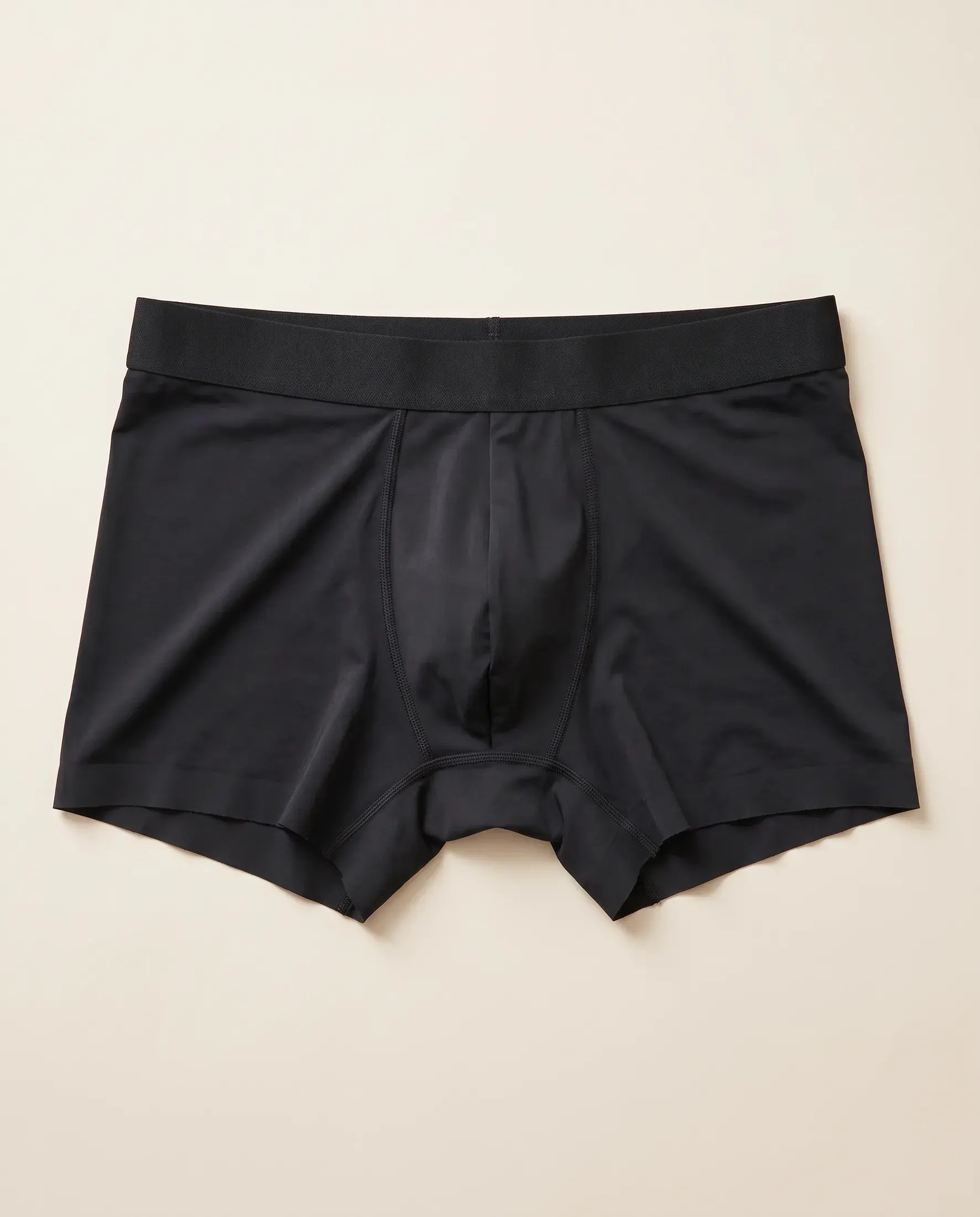
What is a boxer brief?
A boxer brief is a close-fitting undergarment made from stretch knit fabric that combines the supportive seat of a brief with a leg extending partway down the thigh. It is cut to sit against the body rather than hang loose, and typically has a wide elasticated waistband.
The name is literal: it is a brief with a boxer's leg. Everything that distinguishes it from other cuts follows from that one decision to add a leg to a close-fitting garment — the thigh coverage, the support, and the specific way it fails when the leg is cut too short for the wearer.
| Cut | Leg | Fit | What it's for |
|---|---|---|---|
| Boxer brief | Mid-thigh | Close, stretch knit | Everyday wear, support with thigh coverage |
| Trunk | Short — high on the thigh | Close, stretch knit | The same shape, less leg; better under shorter trousers |
| Brief | None | Close, stretch knit | Maximum support, minimum fabric, no thigh coverage |
| Boxer shorts | Long and loose | Loose, usually woven | Airflow and room; no support, bunches under trousers |
When were boxer briefs invented?
Boxer briefs emerged around 1990 and are generally credited to designer John Varvatos during his time at Calvin Klein. That makes the cut roughly three decades old — far younger than briefs, which date to the 1930s, or boxer shorts, which go back to the 1920s.
The timing matters more than the trivia. Boxer briefs only became practical once fine-gauge stretch knits were widely available at scale: the cut depends entirely on fabric that can hold a close fit around the thigh without cutting off circulation. A boxer brief in a non-stretch woven would simply not work.
| Cut | Roughly when | What made it possible |
|---|---|---|
| Boxer shorts | 1920s | Adapted from the shorts worn by boxers |
| Briefs | 1930s | Knit fabric and elastic waistbands |
| Boxer brief | Around 1990 | Fine stretch knits with good recovery |
| Trunk | 1990s onward | A shorter-legged variation on the boxer brief |
What is the point of boxer briefs?
The leg. It covers the inner thigh, which stops skin rubbing against skin when you walk, and it anchors the garment so it doesn't ride into the groin the way a brief can. You get a brief's support without a brief's exposed thigh.
- Thigh coverage prevents skin-on-skin friction — the main cause of chafing when walking or running.
- The close knit holds everything in place rather than letting it shift, which is what boxer shorts do not do.
- It lies flat under trousers instead of bunching, because there is no loose fabric to gather.
- The longer leg gives the garment something to anchor against, so it moves less over a day.
How should boxer briefs fit?
The waistband should sit level without folding over or leaving a deep mark, the seat should be smooth with no loose pouch of fabric, and the leg should lie flat against the thigh without cutting a visible line into it. If all three are true standing still, check them again sitting down.
| Where | Right | Wrong |
|---|---|---|
| Waistband | Level, flat, stays put when you move | Folds over, rolls, or leaves a deep mark |
| Seat | Smooth and close | Loose pouch of fabric, or seams under visible tension |
| Leg hem | Lies flat, finishes below the widest part of the thigh | Rolls into a cord, or climbs within an hour |
The most common fit mistake is treating a riding-up leg as a sizing problem. Going up a size widens the leg opening and reduces the grip holding it in place, so it usually migrates more, not less. If the hem finishes above the widest part of your thigh, the cut is wrong for your leg and no size will fix it.
Frequently asked questions
What are boxer briefs?
A close-fitting knit undergarment that combines the supportive seat of a brief with a leg extending partway down the thigh. It sits against the body rather than hanging loose, and usually has a wide elasticated waistband.
What is the difference between boxer briefs and regular briefs?
The leg. Briefs end at the hip with no thigh coverage at all; boxer briefs continue down the thigh. Both are close-fitting and supportive, but only the boxer brief prevents skin-on-skin friction between the thighs.
What is the point of boxer briefs?
Thigh coverage without giving up support. The leg stops skin rubbing against skin and anchors the garment so it doesn't ride into the groin, while the close knit holds everything in place the way boxer shorts do not.
When were boxer briefs invented?
Around 1990, generally credited to designer John Varvatos at Calvin Klein. They are the youngest of the standard cuts — briefs date to the 1930s and boxer shorts to the 1920s — because they depend on modern fine-gauge stretch knits.
What is the difference between boxer briefs and trunks?
Leg length only. A trunk is the same shape with a noticeably shorter leg, finishing high on the thigh. Trunks sit better under shorter trousers; boxer briefs give more thigh coverage and tend to ride up less.
Are boxer briefs better than boxers?
For support and for wearing under fitted trousers, yes — boxer shorts bunch and offer no support. For airflow and room in heat, boxer shorts are more comfortable. They are built for different priorities rather than one being better.
Where these numbers come from
- Invention and attribution
- The ~1990 date and the attribution to John Varvatos at Calvin Klein are widely and consistently reported, including in the cut's Wikipedia entry. We have not seen a primary company record, so we describe it as generally credited rather than documented.
- Dates for the other cuts
- 1920s for boxer shorts and 1930s for briefs are the commonly reported ranges. Treat all four dates on this page as approximate.
The product behind these guides
The Everyday Brief
Low-rise, no-fly, black, sizes S–XXL. In development — the specs we’ve confirmed and the ones we haven’t are listed on the product page.
Want to know when it’s real?
We’ll email you once, when The Everyday Brief goes on sale. Nothing else.