Fit & sizing
Men’s underwear size guide: how to measure, and why brands disagree
Key takeaways
- Measure where the waistband will actually sit — low, across the hips — not at your natural waist and not where your belt goes.
- Underwear sizes are not trouser sizes. Trouser sizing is vanity-adjusted by brand; underwear charts are usually stated as a body measurement range.
- The same letter size varies by several centimetres between brands, which is why a chart from one label tells you nothing about another.
- If you fall between two sizes, the cut decides: size down for a close fit in a knit with good recovery, size up if the fabric has little stretch.
- A waistband that leaves a deep mark or a leg hem that leaves a ring is a size problem, not a style problem.
- FEELAFTER’s chart is provisional — it mirrors the labelled ranges of our benchmark garment until our own fit testing replaces it.
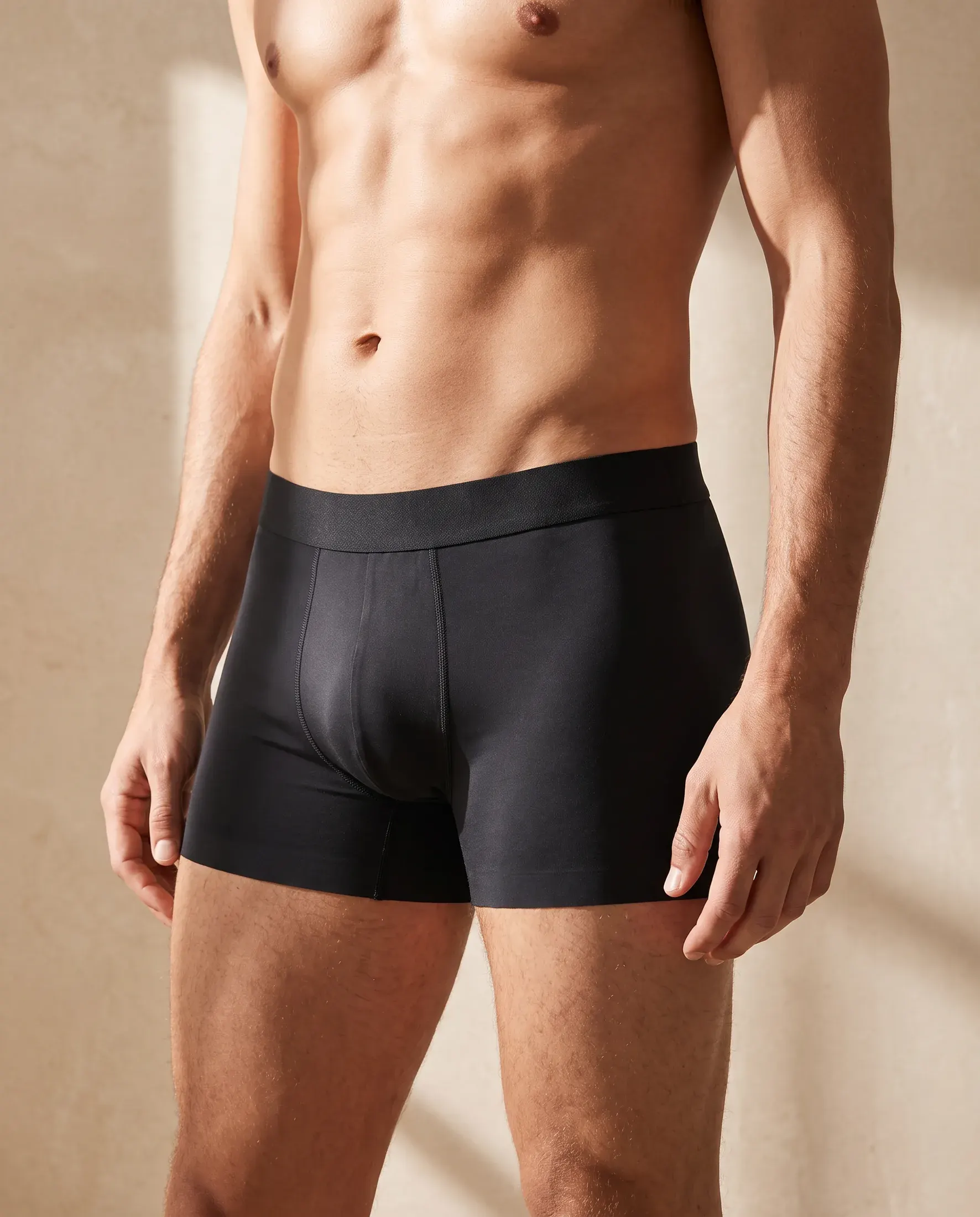
How to measure yourself for underwear
Stand up, wrap a soft tape around your hips where the waistband will sit — low, below the navel and across the top of the hip bones — and keep it level and snug without pulling it in. That number is the one to match against a size chart.
- Measure over bare skin or thin underwear, never over trousers.
- Stand normally. Do not suck in, and do not flex.
- Keep the tape level all the way around — check the back in a mirror.
- Snug means the tape stays up on its own without compressing skin.
- Take the measurement twice. If the two differ, use the larger one.
Why your trouser size is the wrong starting point
Trouser sizes are adjusted for flattery and vary by brand and cut, so a “34” can measure anywhere from about 34 to 38 inches. Underwear charts are usually stated as a body measurement, so a tape gives a reliable answer where a label does not.
| Size | Waist (cm) | Waist (in) |
|---|---|---|
| S | 68–76 | 27–30 |
| M | 76–84 | 30–33 |
| L | 84–92 | 33–36 |
| XL | 92–100 | 36–39.5 |
| XXL | 100–108 | 39.5–42.5 |
What to do if you are between sizes
Let the fabric decide. In a fine knit with elastane and real recovery, size down for a close fit that stays put. In a fabric with little stretch, or if you dislike any compression at the waist, size up.
| Situation | Choose | Why |
|---|---|---|
| Fine knit, 10%+ elastane | The smaller size | Recovery holds the fit; looser means more migration |
| Cotton jersey, little stretch | The larger size | Cotton relaxes as it warms and will not recover |
| Waistband marks your skin | The larger size | That is compression, not fit |
| Leg hem leaves a ring | The larger size or a longer leg | The opening is too narrow for your thigh |
| It rides up but nothing digs in | Same size, longer leg | A size problem and a cut problem are different |
How a correct fit should feel
A correct fit holds position without pressure: the waistband stays level when you sit and leaves no deep mark, the seat is smooth with no loose fabric, and the leg hems sit flat rather than gripping.
- Waistband: stays put through a full day; no rolling, no digging.
- Seat: smooth; no gathered fabric or sagging.
- Front: flat; no bunching when you sit down.
- Legs: flat hems, no rings on the skin, no climbing within the hour.
- After a wash: the same fit as new, which is what fabric recovery means in practice.
Our product-specific chart and fit notes, including what is still unconfirmed, live on the fit guide page.
Frequently asked questions
How do I measure my waist for underwear?
Stand up and wrap a soft tape around your hips where the waistband will sit — low, below the navel — keeping it level and snug without compressing skin. Use that measurement against the brand’s chart, not your trouser size.
Is underwear size the same as trouser size?
No. Trouser sizing is adjusted by brand and is often several inches off the real body measurement. Underwear charts usually state an actual waist range, so measure rather than assume.
Should I size up or down in underwear?
Size down in a fine knit with elastane, where recovery holds a close fit. Size up in cotton or any fabric with little stretch, and size up if the waistband currently leaves a deep mark on your skin.
Why does the same size fit differently between brands?
Because each brand sets its own boundaries for each letter, and differences of two to four centimetres are normal. There is no industry standard, which is why the chart matters more than the letter.
What size is FEELAFTER’s Everyday Brief?
Five planned sizes, S to XXL, on a provisional chart that mirrors our benchmark garment’s labelled ranges — S at 68–76 cm up to XXL at 100–108 cm. The measured FEELAFTER chart will replace it after fit testing.
Where these numbers come from
- Size ranges
- FEELAFTER’s provisional chart, derived from the labelled waist ranges of the benchmark garment described in our benchmark guide. Not yet validated by our own fit testing.
The product behind these guides
The Everyday Brief
Low-rise, no-fly, black, sizes S–XXL. In development — the specs we’ve confirmed and the ones we haven’t are listed on the product page.
Want to know when it’s real?
We’ll email you once, when The Everyday Brief goes on sale. Nothing else.